
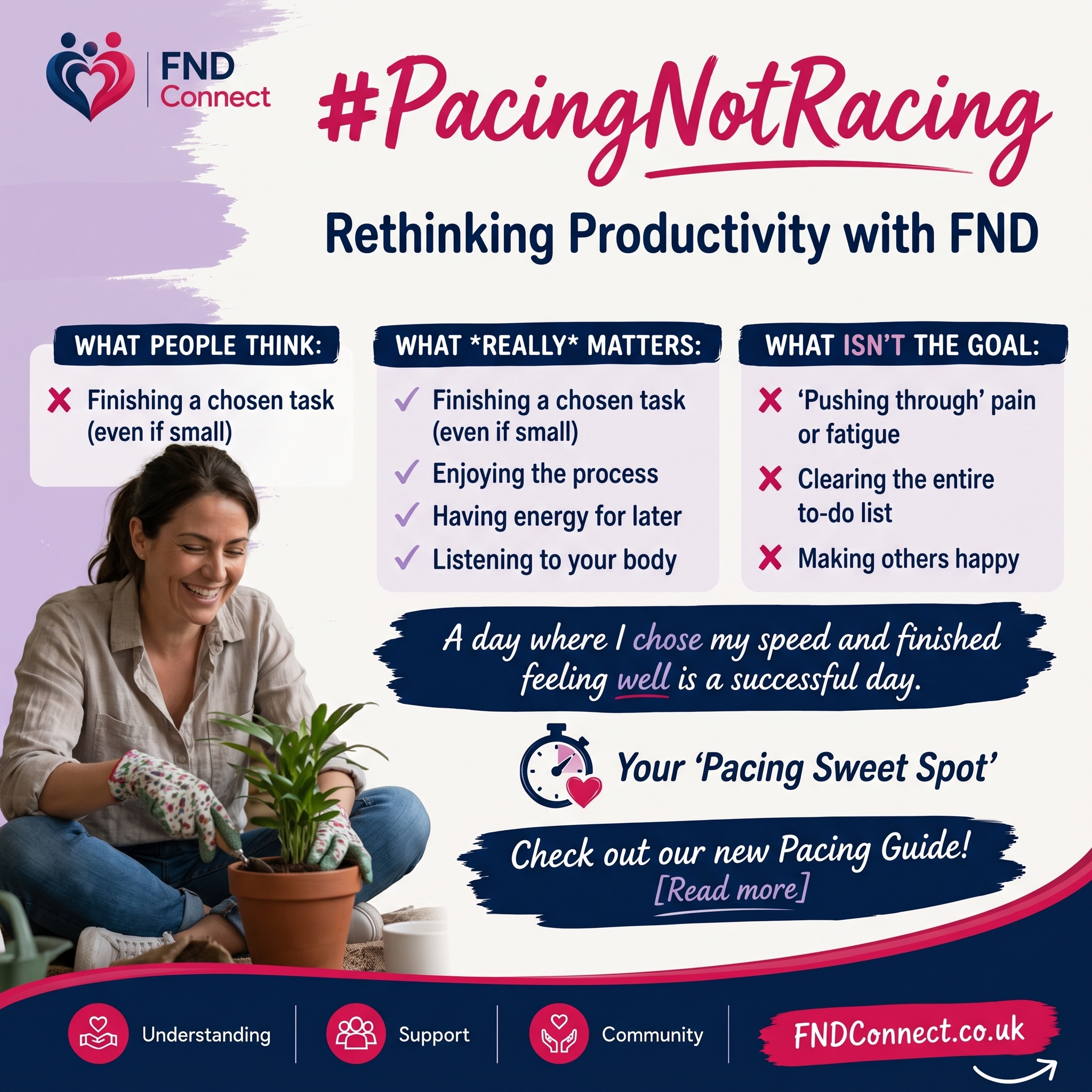
The social post says it simply: pacing is not racing.
For many people with Functional Neurological Disorder (FND), the hard part is not only the symptom itself. It is the pressure to act normal, keep up, finish everything, please everyone and then somehow recover from the crash afterwards.
Pacing is a different way of measuring success. A successful day is not the day you force your body through pain, fatigue or warning signs. A successful day is the day you choose your speed, do something that matters, and still have enough left for later.
A quick safety note: pacing is practical self-management, not a replacement for medical advice, rehabilitation or urgent care. If symptoms are new, sudden, severe, unlike your usual FND pattern, or include possible stroke symptoms, chest pain, breathing difficulty, first seizure, serious injury or loss of safety, seek urgent medical help.
What pacing is
Pacing means planning activity around your current capacity instead of pushing until your nervous system forces you to stop. It is not giving up. It is not laziness. It is not doing nothing.
For FND, activity can mean more than physical movement. It can include thinking, screens, conversation, noise, decision-making, emotion, travel, appointments, sensory input and social pressure. All of those can use capacity.
The aim is to reduce the boom-and-bust cycle: doing a lot on a better day, crashing afterwards, resting until you recover, then trying to catch up again. Pacing creates a steadier rhythm so rehabilitation, work, study, relationships and ordinary life have more room to breathe.
The useful middle is where effort stays repeatable
Life shrinks. Confidence drops. The body and brain get fewer chances to practise safe activity.
You choose a realistic task, pause before empty, and finish with some energy for later.
You push through warning signs, symptoms escalate, and the next day pays the price.
Five steps to find your pacing sweet spot
Find your baseline
For a few days, notice what you can usually repeat without a delayed crash. Your baseline may be smaller than you want. That does not make it pointless; it makes it honest.
Choose one clear task
Pick the smallest useful version of the task. “Tidy the kitchen” might become “clear one surface”. “Exercise” might become “two minutes of clinician-advised movement”.
Stop before empty
Do not wait until symptoms force the stop. Try pausing while you still feel you could do a little more. That margin is what protects the rest of the day.
Build recovery into the plan
Rest is not failure after activity. It is part of the activity. Plan quieter time, hydration, food, reduced sensory load or a change of position before symptoms have to demand it.
Increase gently when stable
If a level is repeatable, you may be able to add a small amount. If it repeatedly triggers a flare, step back and discuss patterns with your clinician, physio or occupational therapist.
What counts as a paced win?
A paced win is not always impressive from the outside. It might be sending one message, showering with a rest afterwards, watering one plant, preparing part of a meal, attending half an event, or leaving before the room becomes too loud.
The important question is not, “Did I do everything?” It is, “Did I choose a realistic amount and protect my ability to function later?”
That shift matters because FND can make symptoms unpredictable. You are working with a nervous system that can become overloaded. Listening earlier gives you more choices than waiting until the only option left is collapse.
Daily examples
- Housework: set a timer for one repeatable block, stop when it ends, and leave the rest for another block or another person.
- Cooking: sit for preparation, use pre-chopped or simple ingredients, and split cooking from washing up.
- Messages: reply to the most important person first, then pause before opening every conversation.
- Appointments: plan travel, waiting time, questions and recovery time as one whole activity, not separate extras.
- Work or study: use shorter focused blocks, written instructions, rest breaks and realistic deadlines where possible.
- Gardening or hobbies: choose a single visible job, use equipment that reduces strain, and stop before the task takes the whole day.
On flare days
On flare days, pacing may look very different. The goal may be safety, symptoms settling, eating something simple, staying hydrated, reducing noise or light, and doing one essential thing only.
Try not to treat a flare day as proof that pacing has failed. FND symptoms can change, and other factors such as poor sleep, pain, stress, infection, hormones, dehydration, sensory overload or a busy previous day can all change capacity.
If flares become more frequent, more severe or different from your usual pattern, that is a reason to seek medical advice. Pacing works best when it sits alongside appropriate clinical support.
How supporters can help
Supporters can make pacing easier or harder. Encouragement helps when it respects the person’s limits. Pressure usually backfires.
- Ask, “What is the useful amount today?” instead of, “Can you just push through?”
- Celebrate stopping early when that protects the rest of the day.
- Offer practical help with setup, travel, meals, forms, noise reduction or backup plans.
- Do not turn a better hour into proof that the person is fine.
- Remember that pacing is about keeping life open, not making life smaller.
Questions to ask your clinician
It can help to take patterns to appointments rather than only describing good days and bad days. Consider asking:
- What symptoms should I treat as urgent, even if I already have FND?
- Would physiotherapy, occupational therapy, speech and language therapy or psychological support help with my current goals?
- How should I pace movement, screens, sensory load, work or study?
- What is a sensible way to increase activity without triggering repeated crashes?
- Are pain, fatigue, sleep, medication side effects or another condition affecting my capacity?
The point of pacing
Pacing is not about becoming the most productive person in the room. It is about building a life that is more repeatable, less punishing and more connected to what matters.
Some days your pacing sweet spot may be a small task. Some days it may be a bigger step. Both can count.
A day where you chose your speed and finished feeling well is a successful day.